Panama Canal Expansion and Real Estate Values: How Infrastructure Growth Is Shaping Panama City Prices
Wondering why some of Panama City’s most desirable addresses used to be US military bases? Panama Elite Homes represents buyers across the neighborhoods this history actually created, and the Canal’s fingerprints on today’s real estate market run deeper — and are more current — than most buyers realize.
It’s tempting to treat the Panama Canal as background scenery for Panama City real estate — a famous landmark that doesn’t much affect where you’d actually want to own property. That’s backwards. The single biggest land-use event in Panama City’s modern history was the Canal itself changing hands, the Canal’s 2016 expansion rewired the country’s entire economic engine, and right now, in 2026, a $2.5 billion monorail tied directly to Canal-era land is actively reshaping which neighborhoods are worth buying into next.
This guide walks through all of it: how the 1999 land handover created some of today’s most established neighborhoods, what the 2016 expansion actually did for Panama’s economy, the water-security risk that doesn’t get enough attention, and the current infrastructure project most likely to move prices in the next three years.
Table of Contents
- The 1999 Handover: How Reverted Canal Zone Land Became Panama City’s Best Addresses
- The 2016 Expansion: Post-Panamax Capacity and the Logistics Real Estate Boom
- Canal Revenue by the Numbers
- The Water Risk Few Buyers Are Pricing In
- Metro Line 3: The Infrastructure Project Actually Moving Prices Right Now
- Which Neighborhoods Are Positioned to Benefit
- Buying With Infrastructure Timing in Mind
- Frequently Asked Questions
Quick Answer: How Does the Panama Canal Affect Panama City Real Estate Values?
| In three distinct ways. First, historically: when the US handed over the Canal and roughly 95,000 acres of surrounding military land to Panama in 1999, that reverted land became today’s Albrook, Clayton, Amador, and the Panama Pacifico special economic zone — some of the city’s most established and highest-demand addresses. Second, economically: the Canal’s 2016 expansion doubled its capacity and generated roughly $5.7 billion in revenue in fiscal 2026, funding national infrastructure that supports broader property values. Third, and most current: Metro Line 3, a $2.5 billion monorail connecting Albrook to Panama Oeste, is over three-quarters complete as of mid-2026 and is already adding measurable price premiums to nearby real estate ahead of its expected 2027–2028 opening. A genuine risk worth understanding: recurring drought has forced the Canal Authority to cut daily transits in 2026, since the same lakes that feed the Canal also supply over half of Panama’s drinking water. |
The 1999 Handover: How Reverted Canal Zone Land Became Panama City’s Best Addresses
Under the Torrijos-Carter Treaties, the United States transferred the Panama Canal and the surrounding Canal Zone to Panama in stages between 1979 and December 31, 1999 — a final handover that included roughly 95,000 acres of land and more than 5,000 buildings, an estimated $4 billion in assets at the time. That single event is arguably the most consequential real estate transaction in Panama’s modern history, and its effects are still the reason certain Panama City neighborhoods look and feel completely different from the rest of the city.
Here’s how some of the most recognizable former military sites became today’s real estate:
| Former Military Site | Today’s Neighborhood | Now Known For |
| Howard Air Force Base | Panama Pacifico (Arraiján) | 141 km² special economic zone; Dell, 3M, Caterpillar, BASF |
| Albrook Air Force Station | Albrook | Albrook Mall, domestic airport, national bus terminal, Metro hub |
| Fort Clayton | Clayton | Restored Canal Zone homes, embassies, Ciudad del Saber |
| Naval/Canal Zone causeway | Amador Causeway | Marinas, waterfront dining, Biomuseo, cruise terminal |
| Canal Zone administrative capital | Balboa / Ancón | Canal administration, government and NGO offices |
This is why Albrook and Clayton feel distinct from the rest of Panama City — low-rise, tree-lined, spacious — while sitting minutes from downtown: they were built to US military housing standards decades before the rest of the city’s condo boom began, and that legacy infrastructure (wide streets, mature trees, generous lots) is largely why both neighborhoods carry a premium today relative to their distance from the financial district.
The 2016 Expansion: Post-Panamax Capacity and the Logistics Real Estate Boom
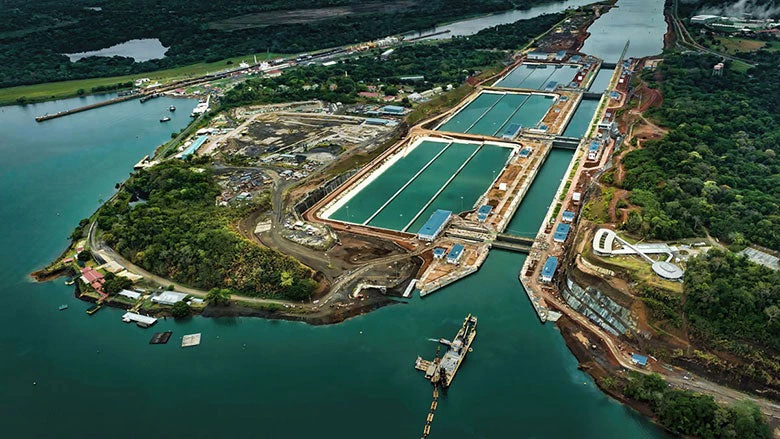
After nearly a decade of construction beginning in 2007, the Panama Canal’s third set of locks opened in June 2016, doubling the Canal’s overall capacity and allowing Post-Panamax vessels — ships nearly three times the cargo volume of the previous size limit — to transit for the first time in the Canal’s history. The $5.25–$7 billion project didn’t just move more ships; it repositioned Panama as a logistics hub capable of competing for global shipping routes that previously bypassed it entirely.
The real estate consequence was concentrated but significant: demand for logistics, warehousing, and light industrial property surged, particularly in the Panama Pacifico special economic zone and the Ciudad del Saber campus — both, notably, also former Canal Zone military land. Industrial and logistics property in Panama Pacifico currently generates gross yields in the 7–9% range, while Grade-A office space along Calle 50 and in Costa del Este runs 6–9%. Our commercial real estate guide covers this side of the market, which most residential-focused buyers overlook entirely.
Canal Revenue by the Numbers
The Canal isn’t just a symbol of Panama’s economy — it’s a direct, measurable line item in it. In fiscal year 2026, the Panama Canal Authority (ACP) reported revenue of roughly $5.7 billion, with the first half of the fiscal year showing 6,288 transits (up 224 year-on-year) and cargo tonnage up about 5%. After the 2023–2024 drought recovery, the ACP delivered close to $3 billion to Panama’s national treasury — funding that flows into the roads, transit lines, schools, and utilities that underpin property values nationwide, not just near the Canal itself.
This is the mechanism worth understanding: Panama’s broader infrastructure investment — including projects like Metro Line 3 below — is meaningfully funded by Canal toll revenue. A strong Canal year tends to precede stronger public infrastructure spending, with a lag of a year or two.
The Water Risk Few Buyers Are Pricing In
Here’s the part most real estate content skips entirely, and it matters for anyone buying with a multi-decade horizon. The Panama Canal runs on fresh water from Gatún Lake and Lake Alajuela — the same lakes that supply drinking water to a large share of Panama’s population, including Panama City. The 2023–2024 drought was the worst in the Canal’s 143-year history, cutting daily transits by as much as 36% at its peak. By early 2026 the Canal had recovered strongly — operating at a 50-foot draft with 36 daily transit slots — but a resurgent El Niño pattern through mid-2026 forced the ACP to cut daily transits back down (36 to 34, with a further cut to 32 planned), a reminder that this risk is cyclical, not solved.
The long-term structural fix is the Río Indio Reservoir, a $1.6 billion project approved in February 2025 that will dam the Indio River and feed additional fresh water into Gatún Lake through a nine-kilometer gravity tunnel — supplying both the Canal and drinking water for more than half of Panama’s population. The catch: construction isn’t expected to begin until 2027, with completion projected for 2032–2033, well after the next El Niño cycle the ACP itself is watching for in 2027. The project also requires relocating roughly 2,000 residents from 37 villages, a politically sensitive process facing organized local opposition. For buyers, the takeaway isn’t alarm — it’s realism: water security is a genuine, multi-year infrastructure risk factor for Panama City, the same way hurricane exposure is a factor in Caribbean markets, and it’s worth understanding rather than ignoring.
Metro Line 3: The Infrastructure Project Actually Moving Prices Right Now
If the Canal’s influence on real estate is mostly historical and macroeconomic, Metro Line 3 is the live, current infrastructure story. This $2.5 billion, 24.5-kilometer monorail connects Albrook — itself reverted Canal Zone land and a Metro Line 1 hub — westward through Nuevo Chorrillo to Ciudad del Futuro in Arraiján, running directly through the Panama Pacifico corridor. As of mid-2026 the project is roughly three-quarters complete, with test runs underway since April 2026; commercial operations are officially projected for around October 2028, after previous target dates slipped.
Once complete, Line 3 is expected to cut the commute between Panama Oeste and downtown from roughly 90 minutes to under 45, directly benefiting over 500,000 residents of that province. The historical pattern for Panama City is well-documented: neighborhoods that gain a new metro station or major road upgrade have typically seen 10–20% price appreciation in the two to three years following completion, with a smaller 3–8% anticipatory bump showing up even before opening once construction milestones make the project feel inevitable. That anticipatory effect is already visible in Panama Pacifico and Arraiján property listings today, well ahead of the line’s actual opening.
Which Neighborhoods Are Positioned to Benefit
- Panama Pacifico and Arraiján— direct Metro Line 3 stations, plus existing multinational corporate demand from the special economic zone.
- Albrook— the eastern terminus and transfer point between Line 1 and Line 3, already Panama City’s best-connected residential neighborhood.
- Clayton— adjacent to Albrook, with lower density and its own former Canal Zone housing stock, likely to see spillover demand.
- Costa del Este— not directly on Line 3, but its corporate tenant base benefits from the broader economic activity Canal revenue and expanded logistics capacity support.
- La Chorrera corridor— the planned second phase of Line 3’s extension; currently among the most affordable zones in the metro area and the furthest out on the appreciation curve.
Buying With Infrastructure Timing in Mind
Infrastructure-driven appreciation rewards patience more than speed. Buying ahead of a confirmed opening date — rather than a construction announcement — tends to capture more of the eventual price movement with less risk of project delay, which Metro Line 3 itself has already demonstrated more than once. Whatever the timing, the underlying legal process doesn’t change: our guide to buying property in Panama as a foreigner covers title verification and closing, and for a broader view of how these corridors compare to the rest of the country, our region-by-region homes guide and rental yield analysis are worth reading alongside this one.
Frequently Asked Questions
1. Which Panama City neighborhoods were built on former Canal Zone land?
Albrook, Clayton, Amador, Balboa, Ancón, and the Panama Pacifico special economic zone were all part of the roughly 95,000 acres handed over from US military control in 1999.
2. Is Metro Line 3 open yet?
No. As of mid-2026 it’s roughly three-quarters complete and in test-running, with commercial operations officially projected for around October 2028.
3. How much did the Panama Canal expansion cost, and when did it open?
The third set of locks cost roughly $5.25–$7 billion and opened in June 2016, doubling the Canal’s capacity and enabling Post-Panamax vessel traffic for the first time.
4. Is the Panama Canal drought a real risk to Panama City real estate?
It’s a genuine, cyclical infrastructure risk rather than an immediate crisis. The 2023–2024 drought was the worst in the Canal’s history, and 2026 has already seen renewed transit cuts tied to El Niño. The long-term fix — the Río Indio Reservoir — won’t be operational until 2032–2033.
5. Which neighborhoods will benefit most from Metro Line 3?
Panama Pacifico, Arraiján, and Albrook sit directly on the line and stand to benefit most, with the La Chorrera corridor positioned for a second-phase extension.
6. Does Canal revenue actually affect real estate outside the Canal Zone itself?
Indirectly, yes. Canal toll revenue — roughly $5.7 billion in fiscal 2026 — funds a meaningful share of Panama’s national infrastructure budget, including projects like Metro Line 3 that shape property values well beyond the Canal’s immediate footprint.
About Panama Elite Homes
Panama Elite Homes curates 170+ active luxury properties across Panama City, Chiriquí Province, Los Santos Province, and Panamá Oeste. The practice specializes in residency-program-eligible investments under the Friendly Nations Visa and Pensionado programs, with in-house legal coordination and full title verification at the Public Registry before any deposit moves.
Curious how a specific neighborhood’s infrastructure exposure affects its long-term outlook? We can walk you through the Metro Line 3 timeline and connectivity story for any property you’re considering. Free buyer consultation — no obligation.
Talk to a Panama Elite Homes advisor | panamaelitehomes.com